

Wisdom teeth: how are they different from other teeth?
“Wisdom teeth” is the name given to the third molars, which come in long after the other teeth. They usually erupt between the ages of 17 and 23, a period once called “the age of wisdom.” They arrive late because of their large size and their position at the back of the mouth: the jaws must have reached their final shape for them to come in. Even so, wisdom teeth do not always have enough room. This results in a variety of eruption patterns, each with its own problems.
A few problematic eruption patterns

- Impaction: The tooth stays impacted, meaning it remains in the bone or gum and never comes out. It is still there, however, and can move in the jaw and harm the roots of neighbouring teeth. An abscess or cyst can also form around it.
- Partial impaction: The tooth does not come in completely and its crown is partly covered by a flap of gum. This makes it vulnerable to food and bacteria getting in. Infections (pericoronitis, cavities, deep gingivitis) can then develop and spread to neighbouring tissues, and even to the alveolar bone. Repeated bacterial attacks can also lead to potentially cancerous lesions.
- Malposition: Wisdom teeth sometimes come in completely but sit abnormally (roots at the wrong angle, outside the dental arch, etc.), which makes them even harder to clean and treat. Their roots can also shift and harm those of neighbouring teeth.
Extractions that are sometimes necessary
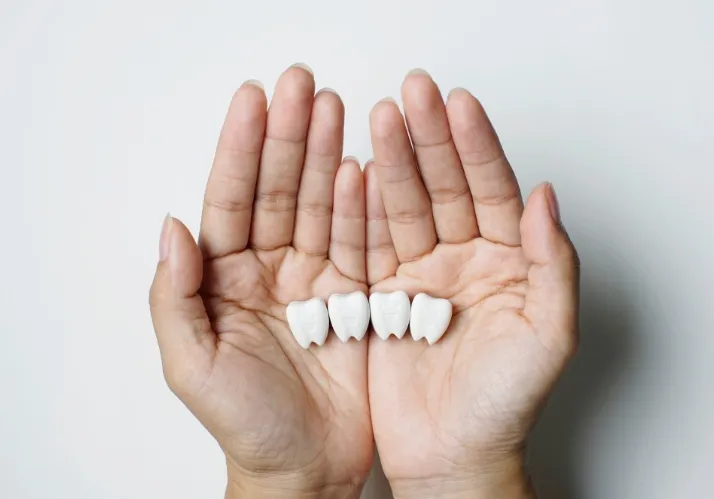
Besides these eruption patterns, the position of wisdom teeth far back in the mouth makes them vulnerable to oral disease and complications. It is sometimes hard to brush and floss these molars properly, and often difficult to treat them when they are diseased. That is why they are extracted in many cases, as treatment (when a problem is already present) as well as prevention (to avoid various conditions and protect neighbouring structures).
Wisdom tooth extraction: it all starts with a good assessment

While extractions are sometimes used to treat diseased wisdom teeth, we generally prefer to remove them as a preventive measure, before problems arise. To determine the risks these teeth pose and whether they should be extracted, your dentist will carry out a complete exam including X-rays. This assessment, like the surgery that often follows, can be done as early as the teenage years, even before the teeth come in!