

As a reminder, from birth to age 10, many treatments are covered by the Régie de l’assurance maladie du Québec (RAMQ):
- Routine exams (once a year);
- Emergency exams;
- Anesthesia (local or general);
- Tooth extractions (teeth and roots);
- Dental X-rays;
- Fillings (amalgam for premolars and molars, composite in some cases);
- Endodontic treatments (some conditions apply);
- Prefabricated dental crowns;
- Oral surgery (services in hospital settings).
Note that preventive care (cleaning, scaling, fluoride application, sealants) is not covered. However, you may be eligible for the Canadian Dental Care Plan in some cases. Ask our team to learn more about these programs.
Preparing for routine visits
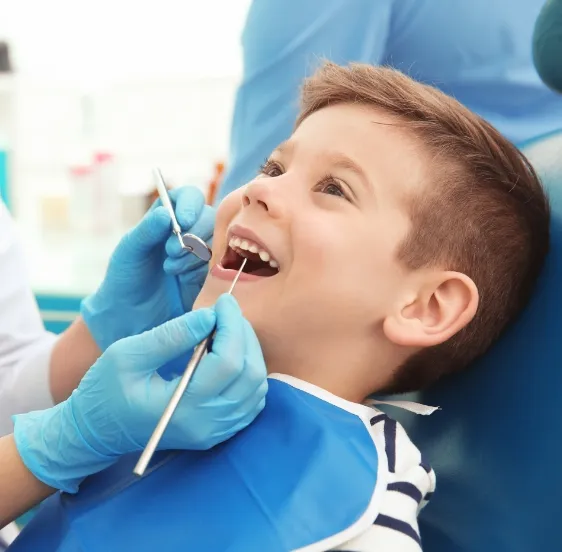
The Canadian Dental Association recommends a first visit to the dentist within 6 months of the first teeth coming in. This lets your dentist check the health and growth of your little one’s mouth and teeth. From age 3, your child can also have a cleaning and a fluoride application. To get the most out of these visits, your child should see us every 6 months.
We know these visits can make young children fearful. That is why it is essential to prepare well for these important appointments.
- Talk about the visit with your child, taking the time to explain why it matters for a healthy mouth. Describe the steps of the appointment and the role of each member of the clinic staff.
- If your child tells you about their fears, acknowledge them without dismissing them or making too much of them. Never tell them it won’t hurt, especially if they haven’t brought it up. That could create new fears, and your child could feel betrayed if they feel any pain.
- If possible, bring your child to the clinic before their appointment so they can discover the place and meet the staff. This could be during a brother’s or sister’s visit.
- Read stories or watch children’s shows about going to the dentist. It is a good way to start a conversation on the subject.
- During your child’s exam, stay relaxed and positive; your own stress could add to your child’s. Respond kindly to the treatment team’s requests. You may be asked to hold your little one, for example, or, if your child is older and more independent, to step out of the room at certain points.
Your toddler’s oral health

Young children can also get oral diseases. That is why it is essential to take care of your child’s mouth and teeth from the first months of life.
A few things to watch:
- Hygiene: Even before the teeth appear, it needs attention. Clean your baby’s gums with a soft cloth after every feeding or meal (purées, solid food). When the teeth come in, use a small brush with very soft bristles instead. From age one, add a little toothpaste (the size of a grain of rice). Start flossing as soon as it is possible and needed.
- Eating habits: Milk (breast milk, formula, cow’s milk) contains sugar, as does juice. Avoid letting your baby fall asleep while drinking or right after. Don’t give a bottle of milk or juice at bedtime. Also keep an eye on snacks and nibbling, and get your little one used to drinking water rather than juice when thirsty.
- Thumb-sucking: This habit (sucking a thumb or a pacifier) is completely normal and usually stops between ages 1 and 3. However, it can cause several problems if it continues past age 3. To help your child give up this soothing reflex, gradually remove the bottle and pacifier between 12 and 18 months. Other methods, such as a bad-tasting “varnish,” can be used if your child keeps sucking their thumb.
Early childhood tooth decay
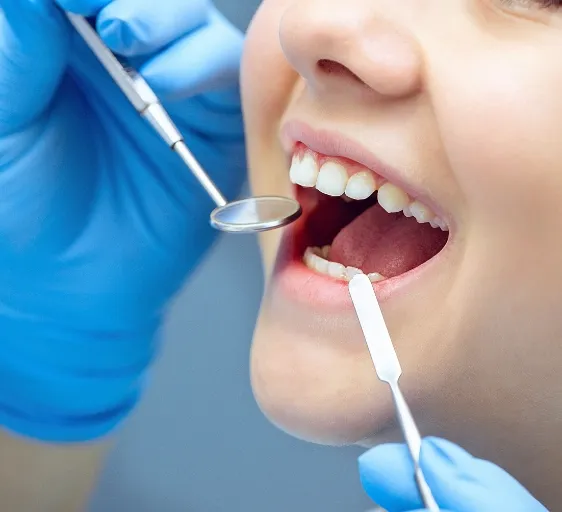
This aggressive disease is a major focus of the children’s dental care offered at Centre Dentaire Ethier & Nadeau in Saint-Eustache. Early childhood tooth decay is the name for decay that attacks baby teeth. Since their enamel is thinner and more fragile, it is easier to break through. When a cavity appears, it can quickly spread to neighbouring teeth and to the structures that support the teeth. It can also damage the corresponding permanent teeth that have not yet come in.
That is why it is essential to fill a decayed baby tooth, even though it will eventually fall out on its own. This prevents several serious consequences:
- Pain and discomfort;
- Poor development of the adult teeth;
- Pulpitis (irritation of the tooth’s nerve) or a deep infection requiring endodontic treatment;
- The infection spreading to all the teeth;
- Removal of the affected teeth, which affects how the smile looks (and potentially the child’s self-confidence) and oral development.
Only your dentist can diagnose early childhood tooth decay. We do ask you, however, to watch for certain signs: dull spots or lines on the teeth (near the gums), teeth that look paler or darker than their neighbours, blackened or browned areas. If the infection is caught in time, a filling will treat it. If other solutions are needed (endodontic treatment, extraction, space maintainer, etc.), we will advise and support you and your child.