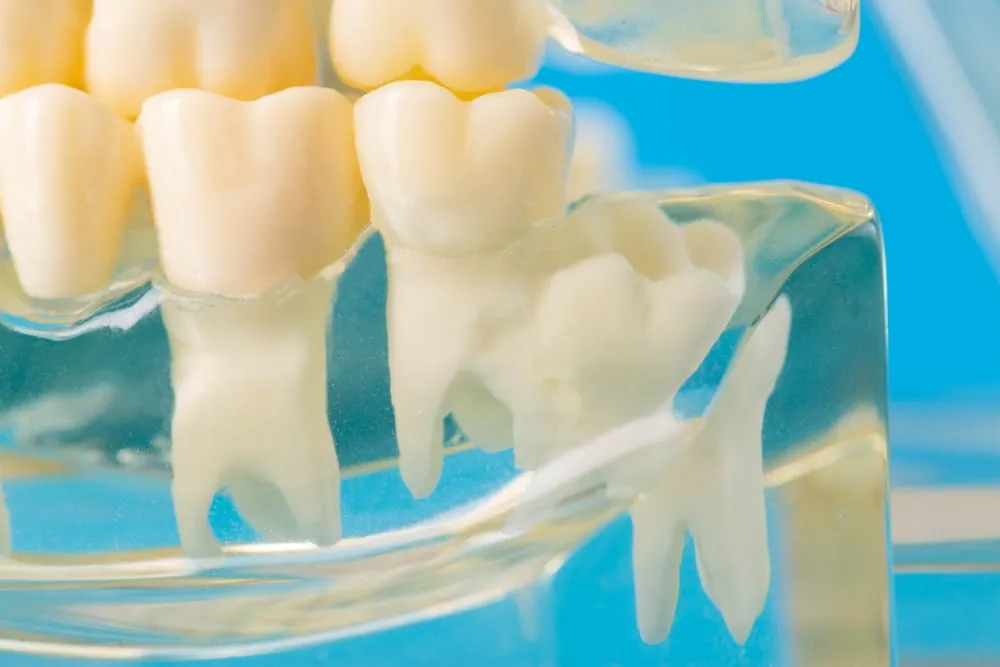
In theory, wisdom teeth are perfectly normal teeth, but in practice, the way they come in is much less so. Located at the very back of the mouth and often short of space, they frequently erupt irregularly. Some come in correctly, while others stay partially impacted, meaning partly covered by gum, or fully impacted in the jawbone. These atypical eruption patterns are common and can cause various complications, even when the tooth itself is healthy. That is why monitoring wisdom teeth from adolescence plays an essential role in preventing problems before they arise. Below, the team at Centre dentaire Ethier & Nadeau explains this important issue.
Infectious complications: areas that are hard to clean
Wisdom teeth sit at the back of the mouth, where brushing and flossing are harder. This position makes hygiene complicated and encourages plaque and bacteria to build up. Several problems can result.
Cavities in the wisdom tooth… or the tooth next to it
When the tooth is partly erupted or poorly oriented, its surface is harder to reach when brushing. It can then develop a cavity, but the tooth just in front of it (the second molar) is especially at risk, since food often gets stuck between the two. This can cause serious damage over time.
Gum infections and pericoronitis
A partially erupted wisdom tooth creates a flap of gum tissue, or a gap near the tooth, where food residue and bacteria easily build up. The resulting inflammation, called pericoronitis, can cause:
- Significant pain;
- Bad breath;
- Facial swelling;
- Difficulty opening the mouth;
- A feeling of pressure around the tooth.
Complications for the other teeth: lack of space and pressure
Although wisdom teeth do not always shift the other teeth, they can contribute to problems when they lack space or grow in the wrong direction.
Pressure on and damage to the second molar
A wisdom tooth angled forward can press on the neighbouring tooth and, over time, cause:
- Wear;
- Resorption of the root and bone;
- Root decay where the teeth touch.
This damage often goes unnoticed without regular exams and X-rays, until it becomes harder to treat.
Crowding
In people whose dental arch is already narrow, wisdom teeth coming in can worsen existing crowding. Even though the direct link with misalignment is not systematic, monitoring helps prevent complications for patients who have already had orthodontic treatment.
Cysts: a silent complication
A wisdom tooth that stays trapped under the gum can develop a dentigerous cyst, a small fluid-filled cavity. Although rare, this can cause:
- Shifting teeth;
- Weakened bone;
- Damage to the jaw.
Since these cysts do not always cause symptoms, only an X-ray can detect them early.
Why monitor wisdom teeth from adolescence?
Between ages 15 and 18, the roots of the wisdom teeth start to form and their position becomes more predictable. The dentist can then:
- Assess the available space;
- Check the eruption path;
- Detect problems before they appear;
- Prevent damage to the other teeth.
Why is preventive wisdom tooth extraction sometimes recommended?
Regular follow-up makes it possible to act at the right time if a tooth is causing, or likely to cause, problems. Even without pain, preventive extraction may be recommended in some cases. It helps to:
- Avoid repeated infections or pericoronitis;
- Prevent cavities or damage to neighbouring teeth;
- Reduce all other risks of complications.
The procedure is also generally simpler in teenagers and young adults. At this age:
- The roots are not fully formed;
- The bone is more pliable;
- Healing is faster after the procedure;
- The risk of post-operative complications is generally lower.
Wisdom teeth do not always cause problems, but when they do, the consequences can be significant. With regular follow-up from adolescence and an X-ray assessment, it is possible to prevent complications and determine whether preventive extraction is the best option. For any question or discomfort, a dental exam remains the best way to ensure proper care.